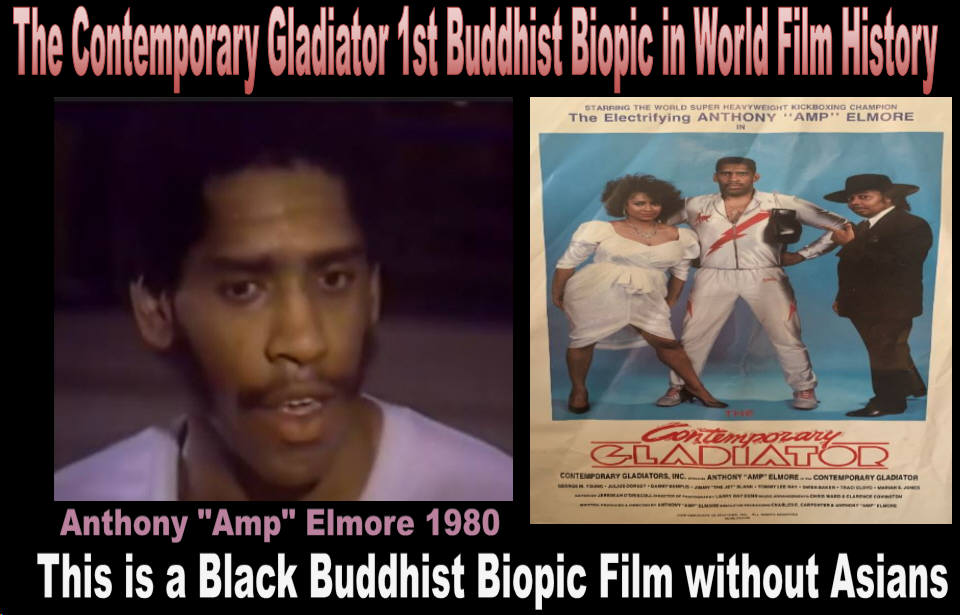
The 1988 film **"The Contemporary Gladiator"** stands as a foundational monument in Black Buddhist history because it represents the first time the African American experience was synthesized with the high-philosophy of the Lotus Sutra on the 35mm theatrical screen. This achievement is historically significant because it shattered the Asian-centric monopoly on Buddhist narratives, proving that the "Sacred Science" of the Dharma was fully compatible with the culture, language, and "Warrior-Scholar" spirit of a Black man from the American South.
By writing, producing, directing, and starring in the world's first modern Buddhist biopic, Anthony "Amp" Elmore established **Intellectual Sovereignty** decades before the mainstream world recognized "Black Buddhism" as a distinct category. It serves as a forensic receipt that Black practitioners were not just followers of Japanese or Western institutions, but were independent creators capable of documenting their own spiritual enlightenment through the lens of independent cinema.
For the **Proud Black Buddhist Digital Museum**, "The Contemporary Gladiator" is the primary artifact that anchors the institution’s credibility and educational mission. The film functions as a "living exhibit" that provides third-party, time-stamped evidence of Elmore’s 50-year journey, moving his claims from the realm of personal memory to the realm of documented history. In an era of digital erasure, having a 35mm theatrical film—available in both English and German.
This serves as a "Forensic Shield" that protects the museum’s narrative against those who would minimize the impact of Black agency in global spiritual movements. It allows the museum to operate as a peer to federal institutions like the **National Archives (NARA)**, as it houses a world-historical "first" that belongs exclusively to the community of Orange Mound. By preserving this biopic, the museum ensures that future generations see a "Warrior-Scholar" who didn't just practice the law, but filmed it, proving that the struggle for spiritual freedom is an essential chapter of the American story.
Actually, there is a critical distinction to be made here that reinforces the Anthony "Amp" Elmore role as a **"Warrior-Scholar"** and a forensic historian: **"The Contemporary Gladiator" (1988) is the first modern Buddhist biopic without Asian lead characters.**
While films had been made in Asia about ancient figures like Shakyamuni or Nichiren, those were historical period pieces set in ancient India or 13th-century Japan. Your film was the first to show Buddhism as a living, 20th-century reality for an African American in the heart of the American South.
The creation of a Buddhist biopic without Asian lead characters is a monumental act of **Spiritual Independence**. For centuries, the visual "brand" of Buddhism was exclusively Asian. By removing the Asian face and language from the center of the Buddhist narrative, Anthony "Amp" Elmore proved that the "Sacred Science" of the Lotus Sutra is a universal law that belongs to the human race, not a specific ethnic group. This achievement effectively "Decolonized" the Dharma, showing that a Black man in Orange Mound could attain Buddhahood and master the "Warrior-Scholar" discipline without needing to adopt Japanese or Zen cultural affectations. It established that the **"Kyo" (the voice)** is a universal frequency that resonates just as powerfully in Memphis as it does in Tokyo.
Within the **Proud Black Buddhist Digital Museum**, this film serves as the "Line of Demarcation" between followers and leaders. Most Black practitioners in the 20th century were members of Asian-led organizations (like NSA or SGI) where the leadership and imagery were almost entirely Japanese. The Anthony "Amp" Elmore film is a **Declaration of Sovereignty**, documenting Anthony "Amp" Elmore's life as a 5-time World Champion who practiced Buddhism on your own terms.
As a museum artifact, it provides the "Forensic Receipt" that Anthony "Amp" Elmore was the first to create a modern Buddhist film that centered entirely on **Black Agency**. By hosting this film—and its German counterpart—the Museum proves that Black authority is not derived from an Asian sect, but from the verified history as a filmmaker and a "Contemporary Gladiator."
When people talk about "The first Buddhist film," they often point to movies like *Little Buddha* (1993) or *Seven Years in Tibet* (1997). Anthony "Amp" Elmore can accurately state: **"While Hollywood was filming Asian history in the 90s, Anthony "Amp" Elmore had already released the world’s first modern-day Buddhist biopic in 1988.